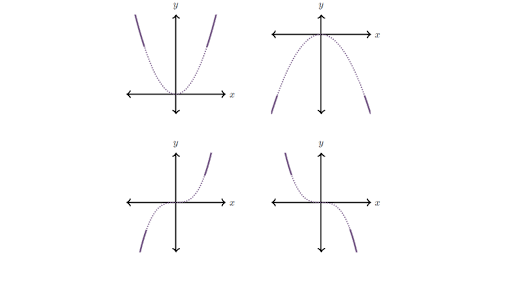
Learn what the endbehavior of a polynomial is, and how we can find it from the polynomial's equation. In this lesson, you will learn what the "endbehavior" of a polynomial is and how to analyze it from a graph or from a polynomial equation.
Explains how to recognize the endbehavior of polynomials and their graphs. Points out the differences between even-degree and odd-degree polynomials, and between polynomials with negative versus positive leading terms.
Polynomial endbehavior is the direction the graph of a polynomial function goes as the input value goes "to infinity" on the left and right sides of the graph.
The behavior of a function as x → ± ∞ is called the function’s endbehavior. At each of the function’s ends, the function could exhibit one of the following types of behavior: The function f (x) approaches a horizontal asymptote y = L. The function f (x) → ∞ or f (x) → − ∞.
In just 5 minutes, this article will help you fully understand the endbehavior of a function, including key concepts, examples, and common mistakes. Perfect for beginners!
What is the endbehavior of a function? Learn the endbehavior rules and how to find the endbehavior. See examples of the endbehavior of different functions.
The *endbehavior* of a function refers to what happens to the outputs as you move farther and farther to the right (x goes to infinity) and farther and farther to the left (x goes to negative infinity).
At its core, endbehavior refers to a function's behavior or trend as the input x approaches positive infinity (x → ∞) or negative infinity (x → ∞). It helps determine whether the graph of a function rises, falls, or levels off at its far ends.